Frank Miller on Storytelling
I’m a huge fan of stories - heroes, myths, legends, and all of that good stuff - and over the years a lot of what I’ve read has shaped how I think, long before I had any idea it was doing so.
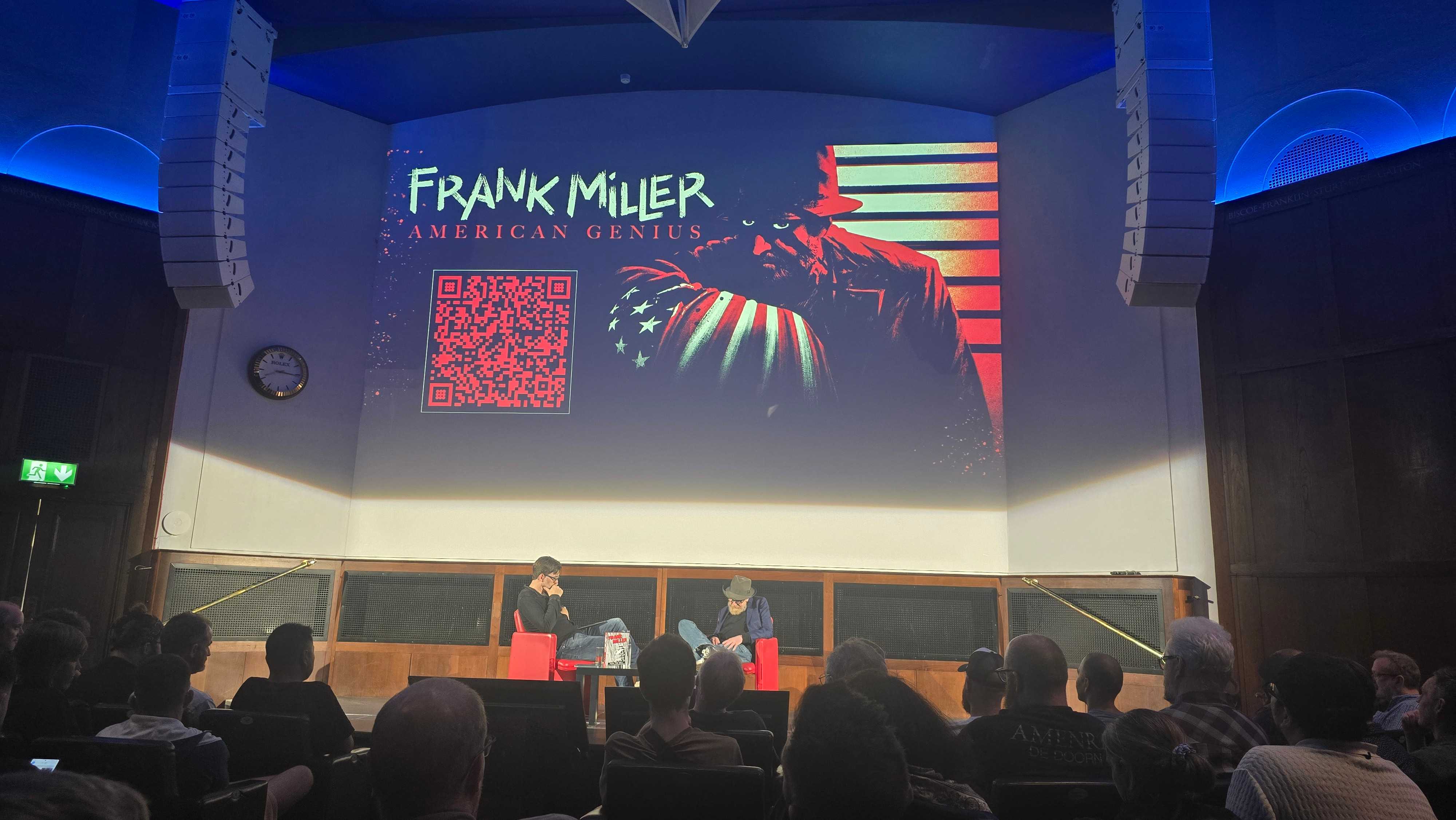
I read The Dark Knight Returns far too young, but I was still blown away - the politics, the media satire, the sheer weight of a man too old and too angry to stop - and I understood it. This was the gateway drug for me into Frank Miller’s work, and I was super excited to watch the man talk about how he does it at an event held at the Royal Geographical Society in London.
The Event
Frank Miller: Storyteller, put on by How To Academy at the Royal Geographical Society in Kensington on Thursday 30th July - an in‑conversation format running about seventy‑five minutes, with a book signing afterwards.
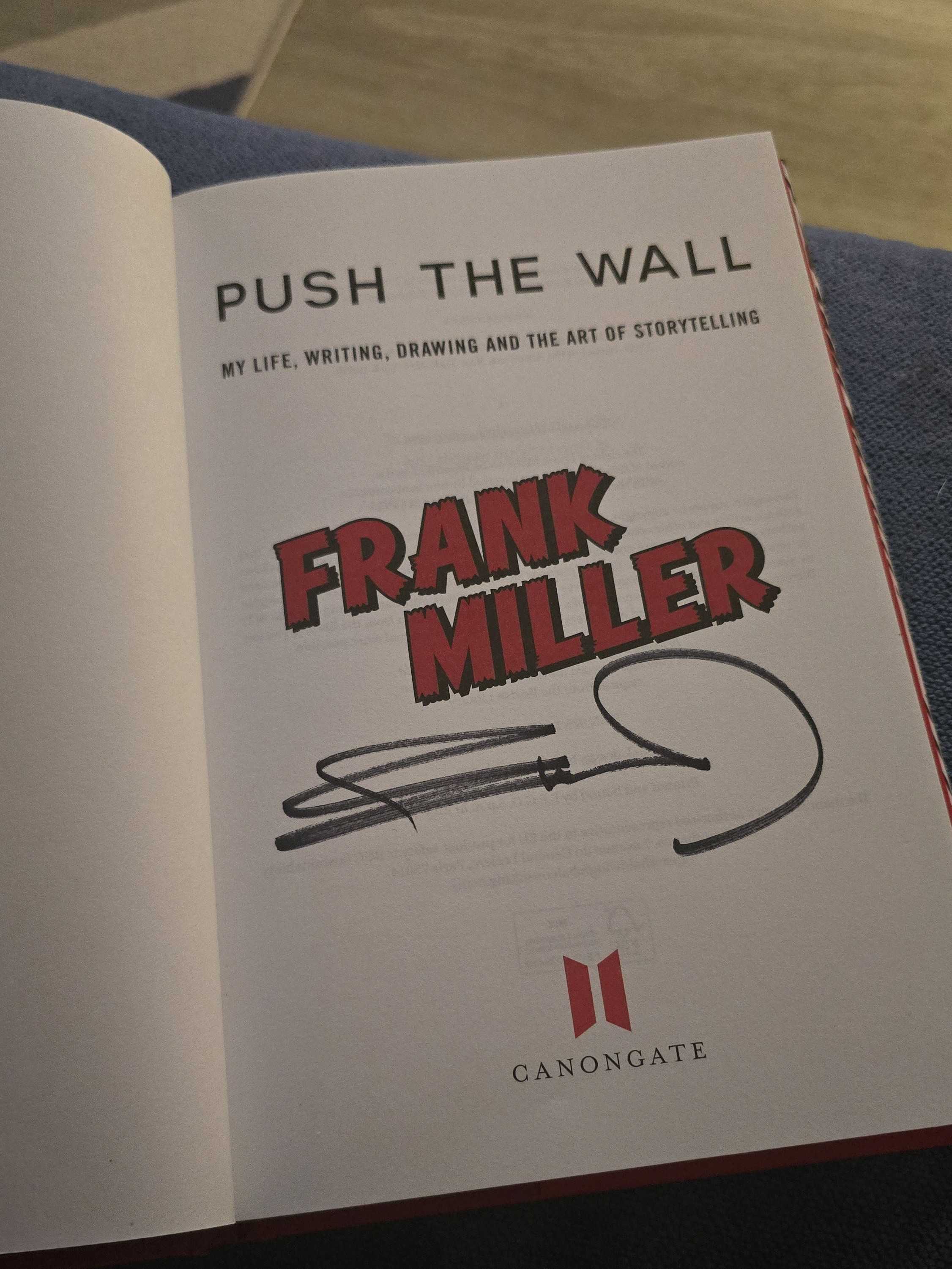
The occasion was Miller’s new book, Push the Wall: My Life, Writing, Drawing, and the Art of Storytelling, published a couple of weeks ago. It’s part memoir, part masterclass - his career distilled into sixteen lessons, running from a seventeen‑year‑old kid arriving in a fairly hostile 1970s New York through to Daredevil, Wolverine, The Dark Knight Returns, Sin City, and 300.
Not only am I a huge fan of Miller’s work, but I’m trying to get to events like this to learn how others in different disciplines work and find out what makes them tick, and hopefully see if I can adapt any inspiration and put it into my own work.
Joe Hill Was the Secret Weapon
The secret weapon that made the event work so well was Joe Hill. He has a famous dad, but he’s a novelist and comics writer in his own right, and that matters enormously here. I’m not too familiar with his work, but after tonight I will absolutely be checking out Locke & Key, NOS4A2, and Heart‑Shaped Box.
He wasn’t there to extract quotes. He was there as a fellow practitioner who’d clearly read the book properly and wanted to argue with bits of it.
He was also, genuinely, very funny. Not “warm‑up act” funny - funny in the way people are when they’re relaxed enough to be quick. He had the room laughing within a couple of minutes and kept coming back to it whenever things got too reverent, which was exactly the right instinct. There’s a version of this event where a legend is placed on a plinth and asked to describe his own genius for an hour. Hill refused to run that version.
The best interviewers make the subject better, and you could see it happening. Miller kept getting pulled off the polished anecdote and into the actual mechanics.
“my dad just sneezes and has a new novel out” was pretty good.
On Storytelling
Back to Miller though - the through‑line of the evening, and of the book, is that storytelling is a craft with rules you can actually learn - and that the learning and putting in the work is not as pleasant as it might seem.
The title says it: Push the Wall. The wall doesn’t move because you’re talented. It moves because you keep shoving.
A few things that landed for me:
Structure is not the enemy of art. Miller is not a “let it flow” romantic. He talks about story like a software engineer talks about infrastructure - what has to be there, what happens if you remove it, what the reader’s attention is actually doing on any given page. That’s a deeply unfashionable position in creative circles and I think he’s right.
Compression is the whole game. Comics force you to decide what the one image is. Everything either earns its panel or gets cut. That discipline is why his prose is so lean and why Sin City works with almost no exposition at all.
The struggle isn’t incidental - it’s the mechanism. This is the one that mattered later. His argument isn’t that suffering is romantic. It’s that the years of doing it badly are where judgement gets built. You cannot skip to the part where you know what to cut.
Learning from failure is a message you hear from quite a lot of successful folk, but here I think he meant it.
The Bit That’s Been Bothering Me
Then came the part that stuck with me - and has been bothering me ever since.
Miller was asked and is, unambiguously, against AI in creative work.
He didn’t hedge it and he wasn’t asked to. It came out as a straightforward statement of position from someone who has spent fifty years learning to draw and write, watching a technology arrive that claims to hand people the output without the fifty years.
And I am trying to build an AI platform that has a storytelling application built on top of it.
I was sitting in a room being told, by someone whose work is part of my own foundations, that the thing I do is a problem - or at least can be seen as a problem if it’s not explained well.
I want to be honest rather than defensive about this, because the defensive version is boring and mostly dishonest.
The strongest form of his argument is not “AI writing is bad.” It’s this: the craft is built by the struggle, the struggle is being sold as removable, and an industry that removes it stops producing people like him. If nobody has to spend a decade being mediocre, where does the next generation of judgement come from? That’s not a complaint. That’s a supply‑chain observation about talent, and I don’t have a clean answer to it.
The second argument is about consent and provenance, and that one has no counter‑argument at all. Models learned from work that artists made, largely without being asked. “But it’s transformative” is a legal position, not an ethical one. If your instinct is to reach for the legal position first, you’ve already conceded the ethical one.
So where does that leave what I’m doing?
The distinction I keep landing on - and I’ll admit I’m not certain it holds - is who the work was going to displace.
Everblossom isn’t competing with Frank Miller or any other huge artist. It isn’t generating a graphic novel to sell in a shop where a human one used to be. It’s generating a story about a child’s specific toy tiger or pet cat, at 7pm, for an audience of one, in a house where the alternative wasn’t a professionally written book - the alternative was no story, or the same story for the ninth time, from a tired‑out parent.
That’s not a market being hollowed out. That’s a thing that mostly wasn’t happening at all.
I’d also argue - and this is where I think the tech industry usually gets it wrong - that the interesting engineering isn’t the generation.
Anyone can call a model. The work in Everblossom is in the narrative work, the developmental psychology, the age‑band structure, the rules about when a frightening moment has to resolve, drawn from real research. That’s craft knowledge, encoded deliberately, by hand. It’s an attempt to teach the machine the rules Miller learned the hard way rather than to pretend the rules don’t exist.
Which, I suspect, he would find an entirely unconvincing defence.
And I think I have to be fine with that, at least for now. The uncomfortable position is the correct one to hold here. I don’t think the answer is for people in my line of work to construct a tidy rebuttal that lets us stop thinking about it - the answer is to keep the objection live, take the consent problem seriously, and be extremely careful about which work we’re actually replacing. Not everything AI can generate is something it should.
If you spend your career building tools that make creative output cheaper, you owe it to the people who made the expensive version to at least know what you’re taking from them.
Worth Going?
Yes - and not just for fans.
If you write anything, in any medium, Miller’s approach to structure is worth the ticket on its own. The evening was properly run, no padding, a host who did the reading, and an hour and a quarter that felt shorter than it was. How To Academy do a lot of these and if the standard is anything like this one, I’ll be back.
I even got to meet the man and got the book signed. I’ve started it, and it’s great. When I finish it, if there’s anything relevant, I’ll come back and add more content here.
I came for the storytelling. I left with more discussion points I’m still having with myself, which is a better result.