Meet Everblossom - The ReplicantCore Showcase
Every story starts with someone or something worth caring about.
Not a character who just happens to share your name, or a tale that nods at your favourite animal in passing - but a story that genuinely meets you where you are. One that speaks in your language, moves at your pace, and earns its ending rather than rushing toward it.
That’s what Everblossom is built for.
A storytelling experience that adapts, remembers, and grows with you and your child.
Here’s an early look at how it works.
See It First
Before we get into what Everblossom does and how it works, here’s the technical preview trailer:

What Is Everblossom?
Everblossom is a storytelling platform with AI‑powered elements - but at its heart, it’s something much simpler. It’s a way to create stories that feel right for the child who’s going to hear them.
You can make your own characters, bring them to life, see them age and remember, and even listen to the story read aloud with different voices for each character.
But the thing that makes Everblossom different isn’t the AI or the fancy buzz word features. It’s the care that goes into making sure every story is genuinely appropriate for the child it’s meant for.
The Experience
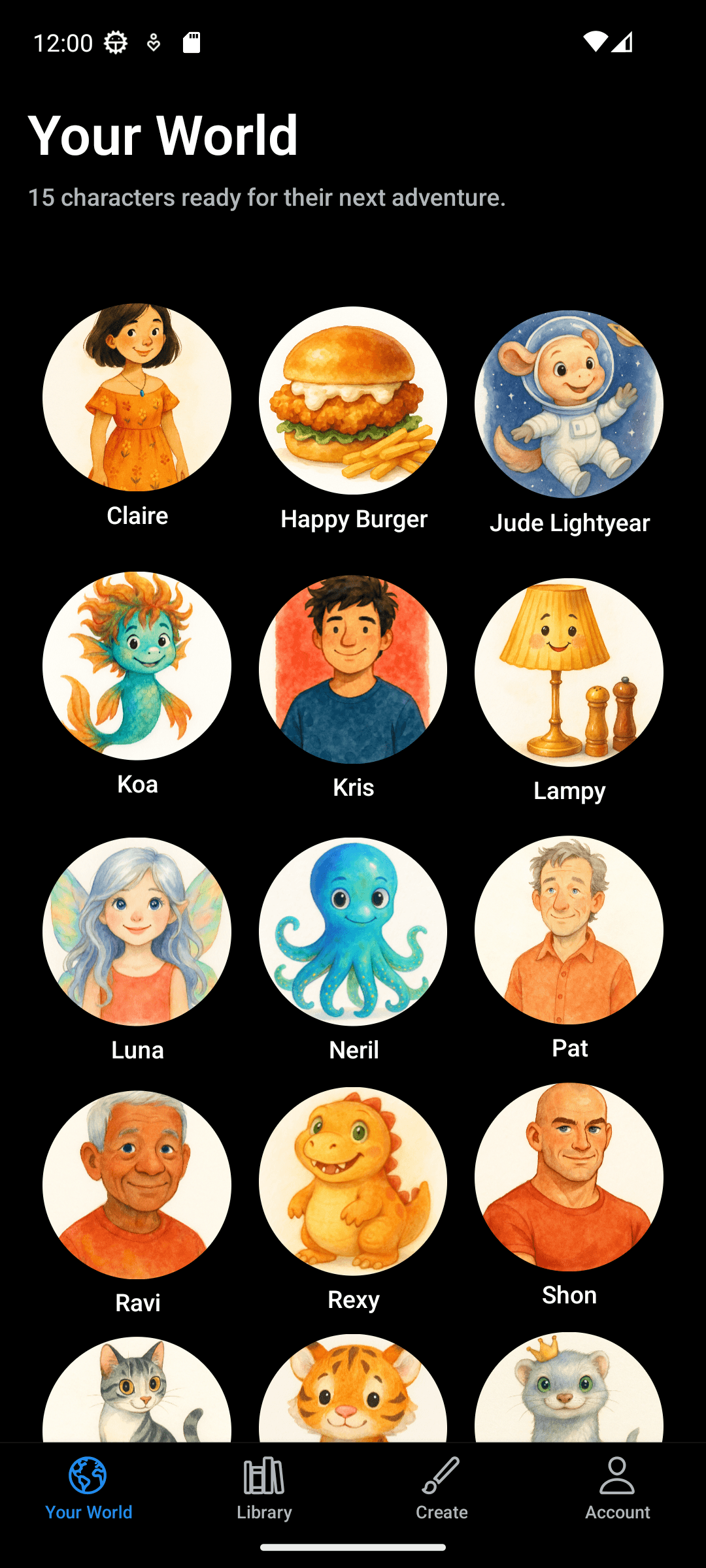
When you open Everblossom, you start with characters.
You can create your own - give them a name, describe what they look like, what kind of person (or “thing”!) they are, what they care about.
Everblossom will even generate a portrait of them. Or you can use your own photo.
Not feeling very creative? No problem. Everblossom can create one for you with 1 button tap, which you can then edit to make your own.
From there, you ask for a story. It can be as simple as “a story about kindness” or as specific as “Mira and the Fox find a lost baby bird in the forest.” You choose how long you want the story to be - short, medium, or long - and who the story is for.
Then Everblossom generates it.
The story arrives complete: chapters, passages, a beginning and a middle and an end that actually resolves.
From there, you can read it on screen or convert it into a full audiocast drama, with every character spoken by a different voice.
The narration is handled by Everblossom’s voice system, which assigns voices to characters and reads the whole story aloud, passage by passage.
You can choose from a list of built in voices, or you can even be in it yourself!
When you come back to a story, Everblossom remembers where you left off.
Built on ReplicantCore
The intelligence behind Everblossom’s story generation is ReplicantCore - the platform’s proprietary AI engine.
ReplicantCore handles everything that requires a large language model or image generator: writing the story text, generating character portraits, analysing uploaded images, and processing books that come in as PDFs, EPUBs, or plain text files. It coordinates with models under the hood and sits between Everblossom and the AI services that power it, while adding a lot of cool stuff in-between.
When you hit “Generate Story,” Everblossom’s backend calls ReplicantCore, which assembles the narrative structure guidelines, sends the request to the language model, and returns the story. ReplicantCore can also handle what happens when you upload a book from your own writing: it extracts the text, identifies the structure, and hands it back to Everblossom ready for processing.
The separation is intentional. Everblossom knows about stories, characters, and readers. ReplicantCore knows about AI. Keeping them distinct means each can be updated, improved, or scaled independently.
Stories That Fit
This is the part that matters most.
Every story generated in Everblossom is shaped by a narrative scaffold - a structured set of instructions, derived from decades of developmental psychology research, that tells the AI how a story should be built for a given age group.
There are five age bands: Reception (0 - 5), Infants (6 - 8), Primary (9 - 11), Secondary (12 - 15), and Young Adult (16+). When you select an age band, the scaffold kicks in.
For example, for a reception-age story, that means:
- Short sentences — around six words on average
- Everyday vocabulary only, nothing unusual or unfamiliar
- A single concrete problem with a single resolution
- Any frightening moment must resolve within the same paragraph
- The moral is stated simply and clearly at the end
For an Infants story, sentences get a little longer, a small set of challenge words becomes available, and the story can hold a little more tension before it resolves. For Primary readers, proper cause-and-effect reasoning arrives. For Secondary and above, full character interiority, moral complexity, and bittersweet endings become available.
None of this is guesswork. The scaffold is derived from the work of real psychologists and data scientists. The guidance the AI receives isn’t a list of academic abstractions; it’s been translated into concrete, actionable instructions that the language model can actually follow.
The result is a story that’s structurally right for its audience - not just vocabulary-adjusted, but genuinely appropriate in arc, pacing, emotional range, and moral resolution.
Safe by Design
Alongside the narrative scaffold, every piece of content in Everblossom - story text, character images, and audiobook audio - passes through ReplicantGuard, the platform’s proprietary content safety layer.
ReplicantGuard scores content across six categories: Violence, Fear, Sexual Content, Profanity, Complex Themes, and Religion. It does this without relying on external ML classifiers - all scoring algorithms are built in-house, combining lexical pattern matching, contextual analysis, linguistic complexity measurement, and (for images) a five-layer computer vision pipeline built from first principles.
The safety thresholds are tied to the same five age-band profiles as the narrative scaffold. A story that’s appropriate for a secondary-school reader may not pass for an Infants profile - and ReplicantGuard makes that call automatically.
This means that when a story is generated for a younger reader, two independent systems are working in the same direction: the scaffold shapes the story to be developmentally appropriate as it’s being written, and ReplicantGuard verifies that the output is safe before it reaches the reader.
Characters That Persist
One of Everblossom’s quieter features (and in my opinion, one of the coolest!) is its character memory system.
When characters appear in stories, the platform tracks what happens to them - key events, relationships, moments of growth or difficulty - using a memory model grounded in cognitive theory. Character memories are scored by recency, frequency, and emotional weight. The characters you’ve built don’t reset between stories, they accumulate a history.
This means stories can acknowledge what came before. A character who helped someone in a previous story can be referenced as someone who does that. A difficulty a character faced doesn’t have to be forgotten. The experience of story becomes continuous rather than episodic.
A Different Kind of Story App
Most story tools ask what you want.
Everblossom also asks who it’s for.
That distinction - taking the audience seriously as a variable in the creative process, not just the reader of whatever gets generated - is what the platform is built around.
The narrative scaffold, the safety layer, the age-band profiles; all of it exists because the same story isn’t right for everyone, and getting it wrong isn’t neutral.
Stories reach people. In the right form, for the right person, at the right moment, they can do something genuinely useful - build vocabulary, model emotional responses, provide comfort, spark imagination.
Everblossom is designed to make that more likely, not less.
difficulty a character faced doesn’t have to be forgotten. The experience of story becomes continuous rather than episodic.
What’s Next?
While the technology is working well, I will be looking to get some real test data very soon. If you like what you see and are interested in beta testing, please do drop me a line.