Film Picture and Audio Formats Explained
Christopher Nolan is releasing The Odyssey this month, and as with every Nolan release, the marketing machine is in full swing. IMAX, IMAX, IMAX. And honestly, for a Nolan film specifically, IMAX genuinely can matter. But here’s the thing — not all IMAX screens are created equal. “IMAX” now covers everything from genuinely extraordinary to slightly bigger than normal with a badge on the door. It’s the Apple of the cinema world.
While working on ReplicantCore & Everblossom I’ve been back in the world of video/audio processing, and with The Odyssey incoming, this felt like the perfect time for a notebook drop.
Let’s break down what’s actually happening when you pick a cinema format - so you can decide whether you’re paying for an experience or a logo.
The Picture: Cinema Formats (What They Are, and Where You’ll Actually See Them)
Aspect ratio is the shape of the image — how wide it is compared to how tall. Different formats use different shapes, film stocks, and projection systems, and they all have their own look and purpose.
Here are the formats you’ll actually encounter in UK cinemas today:
block-beta
  columns 100
  A["IMAX 70mm\n1.43:1"]:14
  space:2
  B["IMAX Digital\n1.90:1"]:18
  space:2
  C["70mm Film\n2.20:1"]:16
  space:2
  D["Flat\n1.85:1"]:17
  space:2
  E["Scope\n2.39:1"]:21
  space:2
  F["35mm\n(varies)"]:12
IMAX Formats
IMAX 70mm — 1.43:1 (True IMAX)
The gold standard. Shot on 15-perf 70mm film, this format delivers enormous vertical scale and staggering detail. Only a handful of UK venues can show it properly:
- BFI IMAX, London
- Science Museum IMAX, London
- Bradford National Science and Media Museum IMAX
- Glasgow Science Centre IMAX
This is the format Nolan designs for.
IMAX Digital / IMAX with Laser — 1.90:1
The multiplex version of IMAX. Still large, bright, and loud, but with a taller-than-widescreen 1.90:1 frame rather than the towering 1.43:1 of true IMAX.
Most UK “IMAX” screens fall into this category:
- Cineworld IMAX
- Odeon IMAX
- Vue IMAX
Large-Format Film
70mm Film — 2.20:1
Classic large-format film used for epics like Lawrence of Arabia and modern special releases like Dunkirk and Oppenheimer. Wider than IMAX 70mm, with a clean, smooth, filmic look. Shown at select venues such as BFI Southbank and Picturehouse Central when available.
35mm Film — Various Ratios
Traditional film stock used for decades of cinema history. Can be projected at 1.37:1, 1.85:1, or 2.39:1 depending on the print. Mostly found in independent or repertory cinemas (Prince Charles Cinema, BFI Southbank).
Standard Widescreen Formats
1.85:1 (“Flat”)
The modern default for most dramas, comedies, and general releases. Fills most multiplex screens with minimal or no black bars. Used across Odeon, Vue, Cineworld, Empire, Showcase, and nearly every standard auditorium.
2.39:1 (“Scope” / Anamorphic)
The ultra‑wide cinematic look. Perfect for action, sci‑fi, and anything with sweeping vistas. Many premium screens in the UK are scope‑native (Cineworld Superscreen, Vue Xtreme, some Odeon Luxe).
Premium Projection Formats
Dolby Vision — 1.85:1 or 2.39:1
Dolby Cinema uses dual‑laser HDR projection with either flat or scope screens depending on the venue. The contrast and colour are unmatched outside true IMAX. Available at select Odeon and Vue locations.
Premium Large Format (PLF) — 1.85:1 or 2.39:1
Formats like Odeon iSense, Vue Xtreme, and Cineworld Superscreen. Bigger screens, better sound, and usually laser projection. Ratios depend on the auditorium: some are flat-native, others scope-native.
Legacy / Specialty Formats
1.33:1 (4:3 / “Old TV”)
A near‑square frame used in early cinema and pre‑HD television. Only appears today for restorations and classics at venues like BFI Southbank, Prince Charles Cinema, and HOME Manchester.
Quick Note: Resolution vs Aspect Ratio
People often mix these up:
- Aspect ratio = the shape of the image (1.85:1, 2.39:1, 1.43:1).
- Resolution = the detail (SD, HD, 1080p, 4K).
You can have any aspect ratio at any resolution. A 2.39:1 film is still 2.39:1 whether it’s 1080p, 2K, 4K, or IMAX 8K.
Common Resolutions
- SD — 480p/576p. Old TV quality.
- HD — 720p. Early HD broadcasts.
- Full HD — 1080p. Baseline for Blu‑ray and most cinema projectors.
- 4K — 2160p. Sharper, especially on large screens.
Why Some Films Look Soft in 4K
1. Many films aren’t shot in 4K
A surprising number of productions shoot at 2.8K or 3.2K, or even 1080p, then upscale to 4K. The file is 4K — the detail isn’t.
2. VFX is usually rendered in 2K
CGI is expensive. Most VFX-heavy films finish at 2K, limiting final sharpness.
3. Style matters
Vintage lenses, grain, low light, or deliberate softness can all make a 4K image look less crisp — intentionally.
Why IMAX Isn’t Just “Higher Resolution”
IMAX 70mm film can exceed 8K–12K
It doesn’t map neatly to digital pixels. When scanned, it resolves far more detail than typical digital sensors.
IMAX digital cameras prioritise sensor size
Cameras like the ARRI Alexa 65 shoot around 6.5K, but with huge sensors that capture more light and dynamic range. The result often looks sharper than higher‑pixel‑count cameras.
IMAX is about scale
On a true 1.43:1 screen, the image fills your field of view. The clarity comes from:
- sheer screen size
- high‑quality capture
- the tall aspect ratio
Not just pixel count.
Why Nolan’s Films Are Different
Nolan mixes aspect ratios. IMAX-shot sequences expand vertically on true IMAX screens, revealing more image top and bottom. On a standard screen, those sequences simply appear as wider shots with black bars.
flowchart LR
    subgraph SCOPE["Scope (2.39:1) on IMAX screen"]
        S_TOP["▒▒ black bar ▒▒"]
        S_IMG["2.39:1 image content"]
        S_BOT["▒▒ black bar ▒▒"]
    end

    subgraph IMAX["IMAX-native shot on IMAX screen"]
        I_TOP[" "]
        I_IMG["1.43:1 — full IMAX frame"]
        I_BOT[" "]
    end

    SCOPE --- IMAX
This only works properly on a true 1.43:1 IMAX screen.
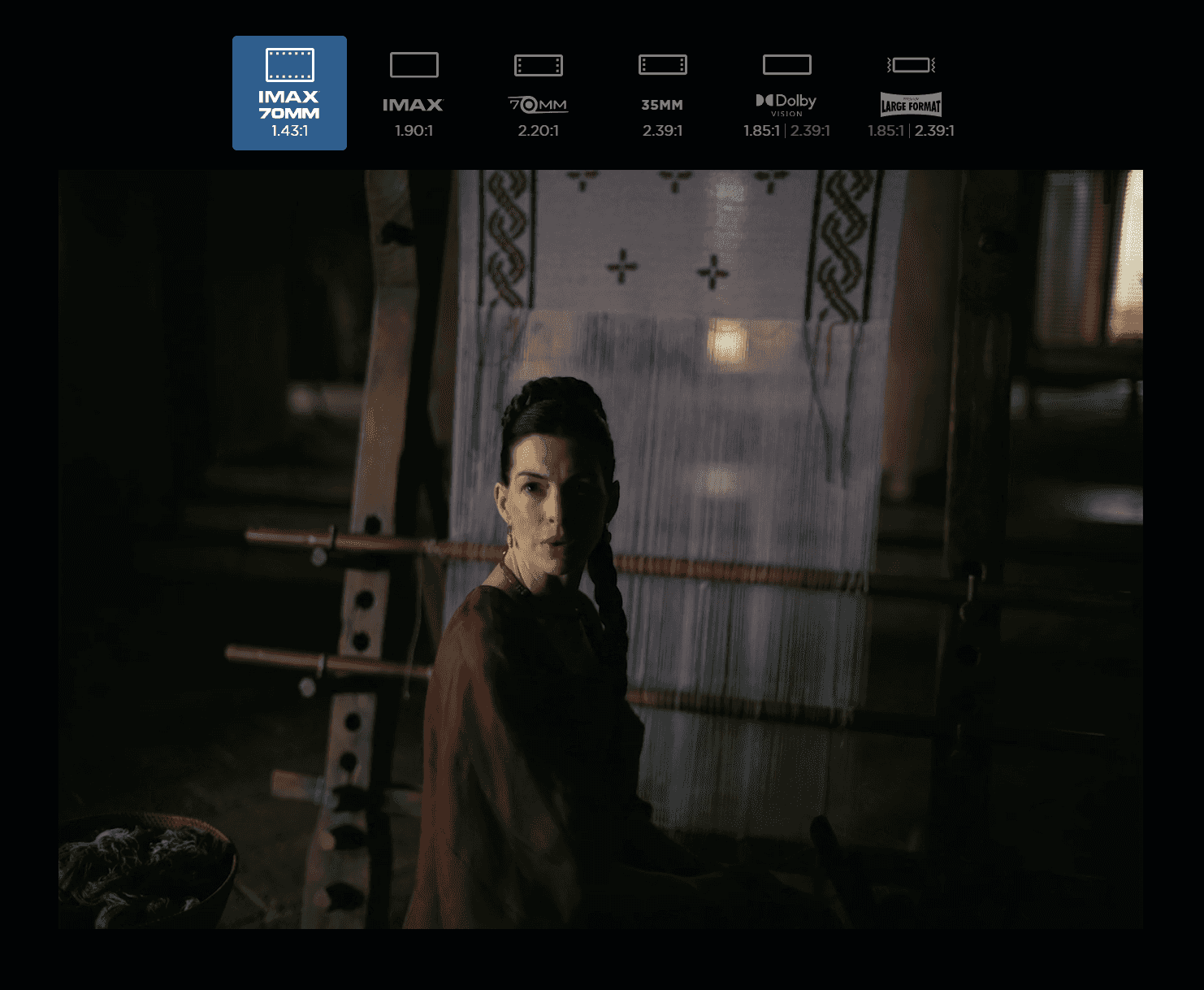
A super cool marketing tool that Universal have come out with is wathing the trailer in any format you want to, so you can see the extra picrture included in the taller formats - check it out here The Odyssey | Explore Premium Formats | July 17, 2026
Digital Projection: 2K vs 4K vs Laser
Most cinemas use DCP (Digital Cinema Package):
- 2K DCP — 2048×1080. Standard across most UK screens.
- 4K DCP — 4096×2160. Sharper, but requires 4K projectors.
Projector technology matters more than resolution:
- Xenon lamp projectors fade over time.
- Laser projectors stay bright, have better contrast, and wider colour.
If a screen has laser projection, that’s a bigger upgrade than 2K vs 4K.
The IMAX Reality
“IMAX” is both a technology and a brand — and in multiplexes, those don’t always match.
True IMAX
- 15/70mm film or IMAX Laser GT
- Native 1.43:1
- Enormous screens (BFI IMAX is 26m × 20m)
IMAX Digital (“Liemax”)
- Smaller screens (17–18m wide)
- Originally 2K, now often laser-upgraded
- 1.90:1 aspect ratio
- Better sound, but not true IMAX scale
Not bad — just different.
UK Cinemas: What You’re Actually Booking
block-beta
  columns 39
  STD["Standard\n~12m wide\n~6.5m tall"]:6
  space:1
  PLF["PLF / iSense\n~15m wide\n~8m tall"]:8
  space:1
  IMD["IMAX Digital\n~17m wide\n~9m tall"]:9
  space:1
  BFI["BFI IMAX\n~26m wide\n~20m tall"]:13
Odeon iSense
4K laser, Atmos, larger screens. Often better value than multiplex IMAX Digital.
BFI IMAX
The real deal. If you can get here for a Nolan film, do.
Cineworld IMAX
Varies by venue — some older, some laser-upgraded.
Vue Xtreme
Large screens, Atmos in many sites, laser at newer ones.
Dolby Cinema
Dual‑laser HDR + Atmos. When available, the most consistent premium experience outside true IMAX.
Sound: From 5.1 to Atmos
Audio is half the experience.
- 5.1 / 7.1 — traditional channel-based surround.
- Dolby Atmos — object-based audio with overhead speakers; the biggest upgrade.
- DTS:X — similar to Atmos, less common.
- IMAX Sound — custom 12‑channel system with huge bass.
Atmos is the most meaningful jump for most films.
When Is the Premium Actually Worth It?
Choose True IMAX (BFI or IMAX Laser GT) when:
- It’s a Nolan film or anything shot for IMAX
- You want maximum visual impact
- You can get to a real 1.43:1 screen
Choose iSense or Dolby Cinema when:
- Your local IMAX is just a multiplex Digital screen
- The film is dialogue‑heavy or intimate
- You want a better seat rather than a bigger screen
- It’s animation or a non‑IMAX‑shot film
For most films, iSense or Dolby Cinema gives you 90% of the experience at a lower price.
The Format Hierarchy
| Picture | Resolution | Projection | Frame ratio |
|---|---|---|---|
| True IMAX / BFI IMAX | 15/70mm or 4K | Laser GT | 1.43:1 |
| Dolby Cinema (Dolby Vision) | 4K | Dual laser HDR | 1.85 / 2.39:1 |
| Odeon iSense / 4K Laser PLF | 4K | Laser | 1.85 / 2.39:1 |
| IMAX with Laser (multiplex) | 4K | Laser | 1.90:1 |
| IMAX Digital | 2K | Laser / Lamp | 1.90:1 |
| Standard 4K | 4K | Laser / Lamp | 1.85 / 2.39:1 |
| Standard 2K | 2K | Lamp | 1.85 / 2.39:1 |
The Odyssey is one of the rare releases where the format marketing is grounded in something real - Nolan shoots for IMAX, and the expanding aspect ratio is part of the storytelling. But even for this film, a well-equipped iSense or Dolby Cinema screen with Atmos is a great experience. The BFI IMAX is the peak, it’s not the only right answer.
For me, my local Odeon with an iSense screen offering 4K with Atmos and lounger style seats has been pretty much perfect for all my cinema outings over the last few years.